2. matter: physical substance
Part 2 of a series that looks at the various definitions of matter from Dictionary.com and how they might apply to compressed creative arts. Here’s definition #2:
physical or corporeal substance in general, whether solid, liquid, or gaseous, esp. as distinguished from incorporeal substance, as spirit or mind, or from qualities, actions, and the like.
For the Matter Press promotional pens, managing editor David Aichenbaum came up with this Matter Press mantra:
solids, liquids, gases, art
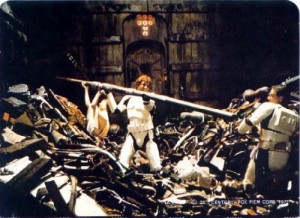
There is something (I’m trying hard here to avoid pretentiousness) in art of the spirit being made into matter. Yes? I know nothing about science, but I think compression in some way changes the form of matter. Let’s just go with that. And that leads me to wonder what forms will come out of compression upon the spirits & minds of writers/artists working with compressed creative arts. For some odd reason, I’m thinking of Luke Skywalker in the garbage compactor, in the Belly of the Beast, a symbolic death and rebirth, from farm-fed teen to force-fed Jedi:
 Joseph Campbell, via Wikipedia:
The idea that the passage of the magical threshold is a transit into a sphere of rebirth is symbolized in the worldwide womb image of the belly of the whale. The hero, instead of conquering or conciliating the power of the threshold, is swallowed into the unknown and would appear to have died. This popular motif gives emphasis to the lesson that the passage of the threshold is a form of self-annihilation. Instead of passing outward, beyond the confines of the visible world, the hero goes inward, to be born again. The disappearance corresponds to the passing of a worshipper into a temple – where he is to be quickened by the recollection of who and what he is, namely dust and ashes unless immortal. The temple interior, the belly of the whale, and the heavenly land beyond, above, and below the confines of the world, are one and the same. That is why the approaches and entrances to temples are flanked and defended by colossal gargoyles: dragons, lions, devil-slayers with drawn swords, resentful dwarfs, winged bulls. The devotee at the moment of entry into a temple undergoes a metamorphosis. Once inside he may be said to have died to time and returned to the World Womb, the World Navel, the Earthly Paradise. Allegorically, then, the passage into a temple and the hero-dive through the jaws of the whale are identical adventures, both denoting in picture language, the life-centering, life-renewing act.
How far afield I’ve gone from matter as solid, liquid, gas to the World Navel! A point, perhaps: Compression forces one into the “interior” and, out of that one discovers “the heavenly land beyond, above, and below the confines of the world.”